Is the Die Fair
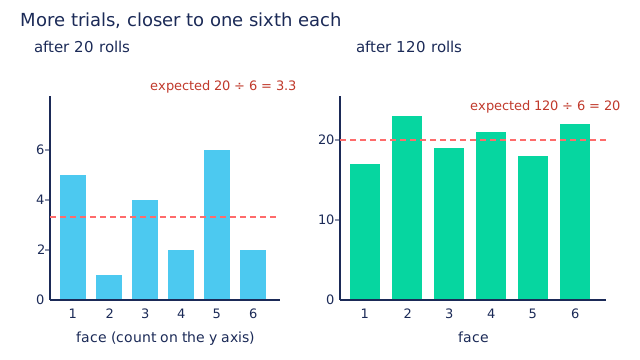
✨ Twenty rolls look wildly uneven, but at 120 rolls the six bars have quietly flattened out.
🧰 You need
- one die
- a cup to shake it in
- paper and pencil for a tally chart
- a calculator
- squared paper
👀 What you will see
After 20 rolls some faces may appear five times and others once. After 120 rolls the bars are far more even, though still not identical. No face is perfectly on 20, and that is expected.
🧪 Do it
- Write down what you expect the six counts to be after 120 rolls.
- Roll the die 20 times, tallying each face, and draw a quick bar chart.
- Continue to a total of 120 rolls, keeping the tally going.
- Work out the expected count for each face by dividing 120 by 6.
- Draw the final bar chart with the expected value marked as a horizontal line.
- Write one sentence on how far your biggest and smallest bars are from the expected line.
💡 Why it happens
Each face of a fair die has a probability of one in six, because there are six equally likely outcomes. With only a few trials, random variation makes the results look lumpy, and that lumpiness is normal rather than evidence of a loaded die. As the number of trials grows, the fraction of rolls showing each face gets closer to one sixth, a result called the law of large numbers. This is why testing a claim needs a large sample, whether you are checking a die or a medicine.
🔁 Now try this
Roll two dice 120 times, tally the totals from 2 to 12, and explain why 7 wins so clearly.
🤔 Think about it
After four sixes in a row, is the next roll any less likely to be a six?
🧘 Ask the Acharya
“After four sixes in a row, is the next roll any less likely to be a six?” — ask him and he will explain it from your own chapters.
More for Std 6–8
Density Tower
Four kitchen liquids sit in four separate stripes in one glass, and a grape parks itself halfway down.
Try it →Science25 minMagnet With a Switch
An ordinary iron nail picks up a pile of paper clips and drops every one of them the instant you break the circuit.
Try it →Science25 minYeast Blows Up a Balloon
A spoonful of dried powder, fed nothing but sugar, inflates a balloon while you watch.
Try it →