Star Student Builder logoStar Student Builder
Tony Buzan's method

Mind Maps: one chapter, one page

Tony Buzan invented mind mapping in the 1970s after noticing that the brain does not think in lists β€” it thinks in branches, colours and pictures. Here is how to build maps that make revision fast and joyful.

Start reading ↓ 🧘 Ask Guru

Mind Maps: one chapter, one page
Anatomy of a great mind mapBuild one in 20 minutesFive ways to use mind mapsWhy mind maps work: the sciencePaper or app?From the library: mind-map books

A mind map is a picture of how ideas connect. Because the whole chapter sits on one page, your eye β€” and your memory β€” can take it in at once. Toppers revise a full subject the night before an exam from 12 such pages.
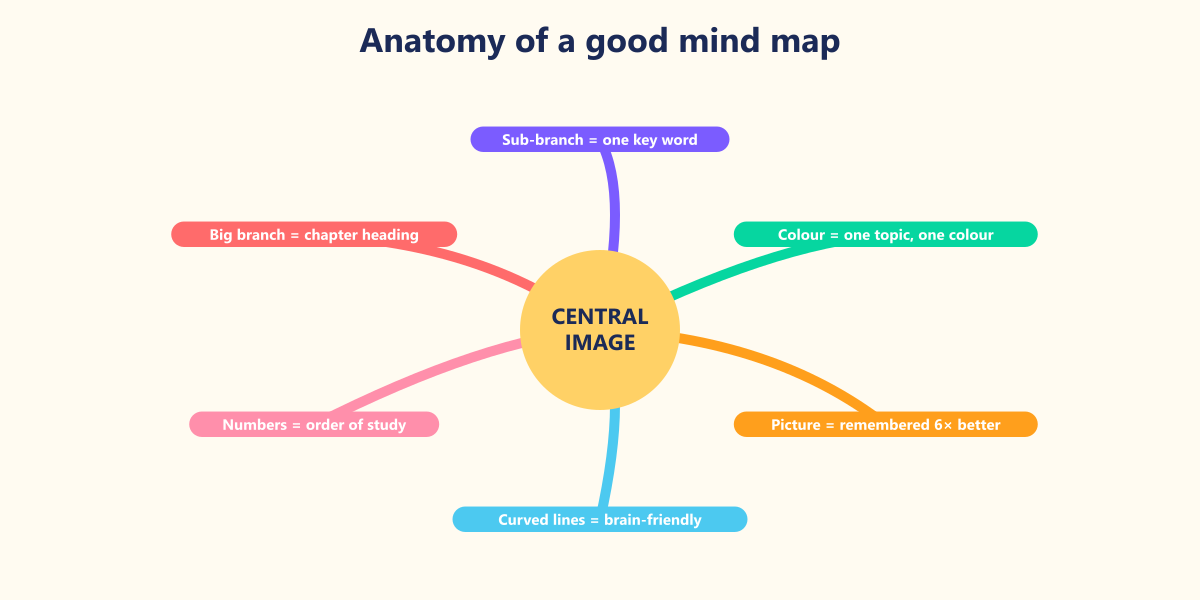
01Anatomy of a great mind map

Buzan's rules: central image, thick curved branches, one keyword per branch, one colour per theme, pictures wherever possible.

02Build one in 20 minutes

Read the chapter first (SQ3R)A mind map is a summary. Mapping while reading for the first time makes a copy of the book, not a map of your understanding.
Draw the centreMiddle of the page, 3–4 colours, the chapter's name and a picture. Spend 2 minutes β€” this image is your recall key.
Add main branches from memoryClose the book. What were the big headings? Draw them. Then open the book to check β€” the checking is where learning happens.
Fill sub-branches, keyword only"Photosynthesis needs sunlight, water and carbon dioxide" becomes a branch "Needs" with three twigs: sun β˜€, Hβ‚‚O, COβ‚‚.
Add formulas, dates and diagramsA mind map for Std X geometry has the theorem statement on the branch and a tiny figure next to it.
Redraw it onceThe second version is always cleaner and half the size. Redrawing is itself a full revision.
Try this todayMap the chapter you studied most recently. 20 minutes, 4 colours, no sentences. Then put the book away and explain the whole chapter to someone using only the map.

03Five ways to use mind maps

πŸ“–

Chapter summary

The classic. One map per chapter; the set becomes your final revision file.

✍️

Essay & answer planning

Before a 5-mark answer or an essay, a 60-second mini-map of points guarantees you do not miss one.

πŸ§ͺ

Comparisons

Two central images (mitosis / meiosis) sharing branches β€” differences jump out visually.

πŸ“…

Exam timetable

Centre: "March exams". Branches: subjects. Twigs: chapters with review dates. Tick as you go.

🎯

Career & life planning

Centre: you. Branches: interests, strengths, dreams, people to ask. Clarity arrives on paper.

🀝

Group study

One big map on a chart paper, each friend owns a branch, then everyone presents theirs. Teaching = strongest learning.

04Why mind maps work: the science

Dual coding + radiant thinkingAllan Paivio's dual-coding theory shows that information stored both as words and as images creates two retrieval paths instead of one. Buzan's radiant thinking adds that the brain's own structure is associative β€” each neuron links to thousands of others β€” so a branching diagram matches how memory is physically organised. Studies with medical students found mind-mapped material retained ~10–15% better after a week than the same material studied as text, with the gap widening over time.

Mind maps also fight the two biggest revision problems: overwhelm (the whole chapter fits on one page, so it feels doable) and passivity (you must decide what matters, which is active thinking).

05Paper or app?

Paper first. Drawing by hand activates motor memory and forces choices about space. Apps are useful for very large maps, sharing with friends, or students who redraw often. Free options: XMind, FreeMind, Coggle, and the built-in drawing tools in any tablet notes app.

06From the library: mind-map books

Books and guides from the Star Student Library for this topic β€” tap Read to open one here, or Download to keep the PDF.

See the whole Books for students shelf β†’

Have a doubt? Ask Guru 🧘

A topic you cannot crack, a definition, a full-marks answer, a question about life β€” Acharya Samayeshwar explains it aloud and in writing, for your board and Std.

Ask Guru β†’
Ask GuruAcharya Samayeshwar