Fourteen Nights of Moon
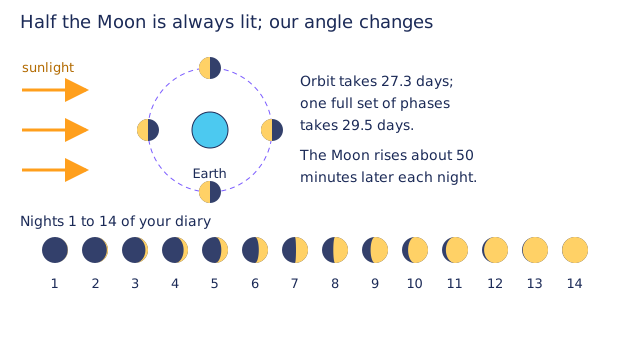
✨ Your fourteen sketches laid in a row show the lit shape sliding smoothly from a thin curve to a full disc.
🧰 You need
- a notebook and pencil
- a phone camera
- a window or spot with a clear sky view
- a compass or a known direction
- a clock
⚠️ Observe from a safe place with an adult knowing where you are.
👀 What you will see
The lit shape changes a little every night, always keeping a smooth curved edge. The Moon appears in a different part of the sky each night at the same clock time, rising later each day. Cloudy nights leave gaps, which is a normal part of real observation.
🧪 Do it
- Pick a spot with a clear view and go there at about the same time each night.
- Sketch the exact shape of the lit part and shade the dark part.
- Write the date, the time and the direction you are looking.
- Photograph the Moon as well, keeping the phone steady against a wall.
- Note whether the Moon is higher or lower than it was the night before.
- After fourteen nights, lay the sketches in date order and describe the pattern.
💡 Why it happens
The Moon makes no light of its own; it only reflects sunlight, so exactly half of it is always lit. As the Moon orbits the Earth once in about 27.3 days, we look at that lit half from changing angles, and the shape we see is called a phase. A complete cycle of phases, new Moon back to new Moon, takes about 29.5 days, slightly longer than one orbit because the Earth has also moved along its own path around the Sun. The Moon rises roughly fifty minutes later each night, which is why the same clock time shows it in a new place.
🔁 Now try this
Also record the time the Moon rises each night, then plot rise time against date and measure the daily delay.
🤔 Think about it
If the Moon is lit by the Sun, why can we sometimes see it in the middle of the afternoon?
🧘 Ask the Acharya
“If the Moon is lit by the Sun, why can we sometimes see it in the middle of the afternoon?” — ask him and he will explain it from your own chapters.
More for Std 6–8
Density Tower
Four kitchen liquids sit in four separate stripes in one glass, and a grape parks itself halfway down.
Try it →Science25 minMagnet With a Switch
An ordinary iron nail picks up a pile of paper clips and drops every one of them the instant you break the circuit.
Try it →Science25 minYeast Blows Up a Balloon
A spoonful of dried powder, fed nothing but sugar, inflates a balloon while you watch.
Try it →