Find Pi in Your Kitchen
✨ A coin, a plate and a bucket all give the same answer, about 3.14, which cannot be a coincidence.
🧰 You need
- a piece of string
- a ruler or measuring tape
- six round objects of very different sizes
- paper and pencil
- a calculator
👀 What you will see
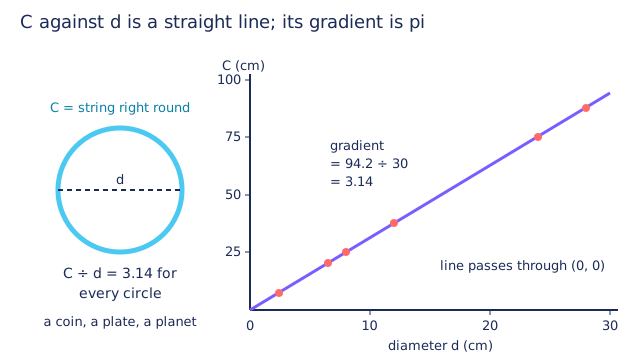
All six ratios come out close to 3.1, with small differences caused by measuring errors. The plotted points lie almost on a straight line that passes through the origin. Bigger objects usually give a more accurate ratio, because a small error matters less.
🧪 Do it
- Wrap the string once around an object, mark the overlap and measure that length as the circumference.
- Measure the widest distance straight across the same object as the diameter.
- Record both measurements in a table, in centimetres, to one decimal place.
- Repeat for all six objects, from the smallest to the biggest.
- Divide circumference by diameter for each object and write the six answers down.
- Plot circumference on the vertical axis against diameter on the horizontal axis and draw the best straight line.
💡 Why it happens
For every circle, the circumference divided by the diameter gives the same number, called pi, which is about 3.1416. This is true for a bangle and for a planet, and it is why the formula is written as circumference equals pi times diameter. Because the relationship is a simple multiplication, plotting circumference against diameter gives a straight line through the origin whose gradient is pi. Your values scatter around 3.14 because string stretches and rulers are read by eye, which is measurement error rather than a fault in the mathematics.
🔁 Now try this
Add three much larger round objects and check whether the gradient of your line moves closer to 3.14.
🤔 Think about it
Pi cannot be written exactly as a fraction of two whole numbers, so how can we know it so precisely?
🧘 Ask the Acharya
“Pi cannot be written exactly as a fraction of two whole numbers, so how can we know it so precisely?” — ask him and he will explain it from your own chapters.
More for Std 6–8
Density Tower
Four kitchen liquids sit in four separate stripes in one glass, and a grape parks itself halfway down.
Try it →Science25 minMagnet With a Switch
An ordinary iron nail picks up a pile of paper clips and drops every one of them the instant you break the circuit.
Try it →Science25 minYeast Blows Up a Balloon
A spoonful of dried powder, fed nothing but sugar, inflates a balloon while you watch.
Try it →