Rubber Band Car
✨ Winding a rubber band ten times sends a cardboard car three metres across the floor with no batteries at all.
🧰 You need
- stiff cardboard for the body
- four bottle caps for wheels
- two thin sticks or straws for axles
- rubber bands
- tape
- a measuring tape
⚠️ A rubber band can snap back, so keep it away from your face and eyes.
👀 What you will see
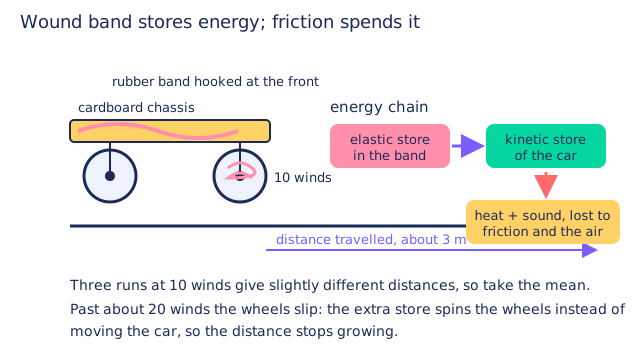
The car lurches forward as the band unwinds and then coasts. Three runs at the same number of winds give slightly different distances, so an average is fairer. Too many winds often makes the wheels spin without gripping.
🧪 Do it
- Make a cardboard chassis and tape two straws across it as axle holders.
- Push a stick through each straw and fix a bottle cap on each end, checking that the wheels spin freely.
- Hook one end of a rubber band to the front of the chassis and loop the other around the rear axle.
- Wind the rear axle backwards ten turns, holding the wheels off the ground.
- Set the car down, release it, and measure how far it travels.
- Run it three times at ten winds and calculate the average distance.
💡 Why it happens
Stretching or twisting a rubber band stores energy in the stretched rubber, called elastic potential energy. Releasing it turns that store into the energy of movement, called kinetic energy, through the axle and wheels. Friction between the wheels and the floor, plus air resistance, steadily removes energy as heat and sound, which is why the car slows and stops. Beyond a certain number of winds the wheels can no longer grip, so the extra stored energy is wasted in spinning rather than moving.
🔁 Now try this
Measure the distance for 5, 10 and 15 winds with three runs each, then plot average distance against number of winds.
🤔 Think about it
Where exactly does all the stored energy end up once the car has stopped?
🧘 Ask the Acharya
“Where exactly does all the stored energy end up once the car has stopped?” — ask him and he will explain it from your own chapters.
More for Std 6–8
Density Tower
Four kitchen liquids sit in four separate stripes in one glass, and a grape parks itself halfway down.
Try it →Science25 minMagnet With a Switch
An ordinary iron nail picks up a pile of paper clips and drops every one of them the instant you break the circuit.
Try it →Science25 minYeast Blows Up a Balloon
A spoonful of dried powder, fed nothing but sugar, inflates a balloon while you watch.
Try it →