Which Beam Shape Wins
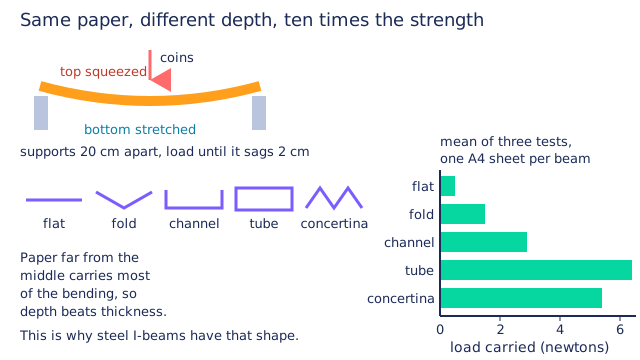
✨ Five beams made from identical sheets of paper differ in strength by more than ten times, purely because of shape.
🧰 You need
- five identical A4 sheets
- sticky tape
- two book stacks as supports
- a pile of identical coins
- a kitchen scale and a ruler
⚠️ Ask an adult before cutting, and keep the book stacks low so nothing heavy can topple.
👀 What you will see
The flat sheet fails at a handful of coins while the closed tube and the concertina hold many times more. Repeat tests of one shape agree reasonably well, so the differences between shapes are real. Failure is usually a sudden buckle or crease rather than a tear.
🧪 Do it
- Weigh one coin on the scale and set the two supports exactly 20 centimetres apart for every test.
- Make five beams from one sheet each: flat, single fold, U channel, closed tube and concertina.
- Rest the first beam on the supports and add coins at the centre until it sags by 2 centimetres.
- Record the number of coins, then repeat that test twice more with fresh beams of the same shape.
- Test all five shapes the same way and calculate the mean coin count for each.
- Convert each mean to a load in newtons by multiplying coin mass in kilograms by the count and by 9.81.
- Draw a bar chart of load against shape and note which shape failed most suddenly.
💡 Why it happens
Every beam here contains the same amount of paper, so any difference in performance comes from how that paper is arranged. Bending squeezes the top surface and stretches the bottom, and material placed far from the middle carries most of that load, a property engineers call the second moment of area. Folds, channels and tubes give the beam depth, and stiffness rises much faster with depth than with the amount of material, which is why doubling depth beats doubling thickness. This is exactly the reasoning behind steel I-beams, hollow bicycle frames and corrugated roofing.
🔁 Now try this
Take the winning shape and test it over spans of 20, 30 and 40 centimetres, then plot load against span.
🤔 Think about it
Why is a hollow steel tube stiffer than a solid rod made from the same mass of steel?
🧘 Ask the Acharya
“Why is a hollow steel tube stiffer than a solid rod made from the same mass of steel?” — ask him and he will explain it from your own chapters.
More for Std 9–12
Measure Gravity With a String
Six lengths of string, a stopwatch and one graph hand you the strength of Earth's gravity to within a few per cent.
Try it →Science40 minHow Fast Does It Fizz
The kitchen scale reading falls in real time, and the steepness of that fall is the speed of the reaction.
Try it →Science30 minHeart Rate Recovery Curve
The shape of your own recovery curve says more about your fitness than the peak number ever could.
Try it →