Measure Gravity With a String
✨ Six lengths of string, a stopwatch and one graph hand you the strength of Earth's gravity to within a few per cent.
🧰 You need
- about 1.5 metres of thin string
- a heavy nut or a bunch of keys as the bob
- tape and a doorframe or shelf edge
- a measuring tape
- a phone stopwatch
👀 What you will see
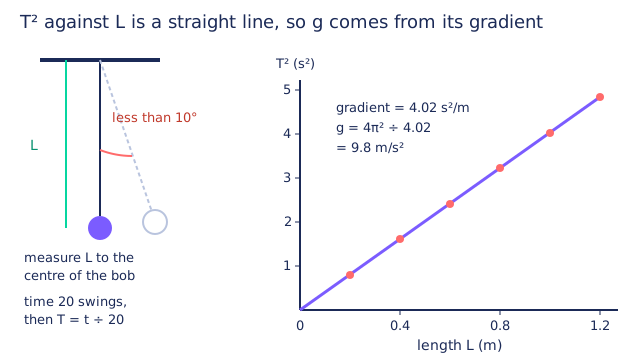
Short pendulums swing noticeably faster than long ones. The plot of period squared against length is a straight line through the origin, not a curve. The gradient gives a value for g near 9.8 metres per second squared, usually a little off because of timing error.
🧪 Do it
- Tape the string to a fixed edge and tie the bob on, then measure the length from the pivot to the centre of the bob.
- Pull the bob aside by less than ten degrees and release it without a push.
- Time twenty complete swings, divide by twenty to get the period, and repeat three times.
- Shorten the string and repeat for six lengths between about 20 and 120 centimetres.
- Tabulate length, mean time for twenty swings, period and period squared.
- Plot period squared on the vertical axis against length, draw the best straight line and find its gradient.
- Calculate gravity from the gradient using g equals four pi squared divided by the gradient.
💡 Why it happens
For small swings the period of a pendulum is T equals two pi times the square root of length divided by g, where g is the gravitational field strength. Squaring both sides gives T squared equals four pi squared over g, multiplied by length, so plotting T squared against length must give a straight line whose gradient is four pi squared divided by g. The period does not depend on the mass of the bob, nor much on the size of a small swing, so those are the variables you keep controlled. Timing twenty swings instead of one divides your reaction-time error by twenty, which is the single biggest improvement you can make.
🔁 Now try this
Hold the length fixed at one metre and change the bob mass in three steps, to confirm that period really is independent of mass.
🤔 Think about it
A pendulum clock runs slightly slow on a hot day, so what must be happening to its rod?
🧘 Ask the Acharya
“A pendulum clock runs slightly slow on a hot day, so what must be happening to its rod?” — ask him and he will explain it from your own chapters.
More for Std 9–12
How Fast Does It Fizz
The kitchen scale reading falls in real time, and the steepness of that fall is the speed of the reaction.
Try it →Science30 minHeart Rate Recovery Curve
The shape of your own recovery curve says more about your fitness than the peak number ever could.
Try it →Science40 minMeasure the Sun With a Pinhole
Two measurements on a sheet of paper let you calculate the diameter of the Sun, a million times further away than you can walk.
Try it →