Measure the Sun With a Pinhole
✨ Two measurements on a sheet of paper let you calculate the diameter of the Sun, a million times further away than you can walk.
🧰 You need
- two pieces of stiff card
- a pin
- white paper for a screen
- a measuring tape
- a sunny day and an open window or doorway
⚠️ Never look directly at the Sun or through the pinhole; look only at the paper screen.
👀 What you will see
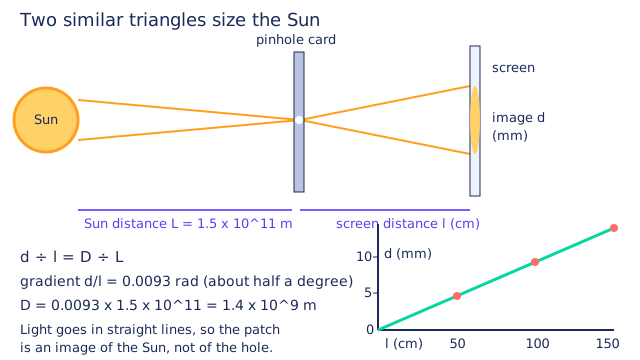
The patch of light is a round disc, not a pinhole shape, and it grows in proportion to the distance. At one metre the disc is about nine millimetres across. Your gradient should come out near 0.0093, giving a Sun diameter close to 1.4 times ten to the ninth metres.
🧪 Do it
- Make one clean pinhole in the centre of a card and tape the white paper to the second card as a screen.
- Stand with your back to the Sun, holding the pinhole card so sunlight passes through it onto the screen.
- Move the screen back until you see a clear round bright disc, and measure the screen distance with the tape.
- Measure the diameter of the bright disc carefully, to the nearest millimetre.
- Repeat at screen distances of about 50, 100 and 150 centimetres and record each pair of values.
- Plot image diameter against screen distance, draw the best line and take the gradient as the angular size.
- Multiply that gradient by the Sun's distance of 1.5 times ten to the eleventh metres to get the Sun's diameter.
💡 Why it happens
Because light travels in straight lines, a pinhole forms an image of the Sun rather than a spot of the hole's own shape. The triangle from the hole to the image is similar to the triangle from the hole to the Sun, so image diameter divided by screen distance equals the Sun's diameter divided by the Sun's distance. That ratio is the Sun's angular size, about 0.0093 radians or roughly half a degree, and it is what your gradient measures. Multiplying by the known Sun distance converts an angle into a real diameter, which is exactly how astronomers size distant objects.
🔁 Now try this
Repeat the whole measurement with a slightly larger hole and explain, from your graph, why the image gets brighter but less sharp.
🤔 Think about it
The Moon happens to make almost the same sized disc in our sky, so what spectacular event does that coincidence allow?
🧘 Ask the Acharya
“The Moon happens to make almost the same sized disc in our sky, so what spectacular event does that coincidence allow?” — ask him and he will explain it from your own chapters.
More for Std 9–12
Measure Gravity With a String
Six lengths of string, a stopwatch and one graph hand you the strength of Earth's gravity to within a few per cent.
Try it →Science40 minHow Fast Does It Fizz
The kitchen scale reading falls in real time, and the steepness of that fall is the speed of the reaction.
Try it →Science30 minHeart Rate Recovery Curve
The shape of your own recovery curve says more about your fitness than the peak number ever could.
Try it →