How Fast Does It Fizz
✨ The kitchen scale reading falls in real time, and the steepness of that fall is the speed of the reaction.
🧰 You need
- baking soda
- white vinegar and water for dilution
- a kitchen scale reading to 1 gram
- a tall glass or jar
- a measuring cup and spoon
- a phone timer
⚠️ Keep vinegar away from your eyes, wipe spills at once and keep the scale dry.
👀 What you will see
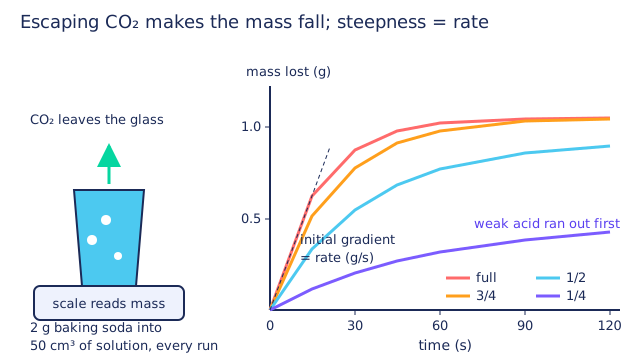
The mass falls fastest in the first few seconds and then levels off. Stronger vinegar gives a steeper start and reaches its final mass loss sooner. All four runs with the same 2 grams of baking soda end at a similar total loss, provided enough acid was present.
🧪 Do it
- Make four vinegar solutions of 50 millilitres each: full strength, three quarters, half and one quarter, topping up with water.
- Weigh 2 grams of baking soda for every run so that this variable stays fixed.
- Stand the glass of one solution on the scale, note the total mass, then tip in the baking soda and start the timer.
- Read the mass every fifteen seconds for two minutes and write every reading down.
- Repeat for the other three concentrations, using the same glass, room and volumes.
- Plot mass lost against time for all four runs on one set of axes.
- Measure the gradient of each curve over the first thirty seconds and compare the four initial rates.
💡 Why it happens
Acetic acid in the vinegar reacts with sodium hydrogen carbonate to produce carbon dioxide, which escapes into the room, so the falling mass measures how much gas has been made. Rate of reaction is the change in that mass divided by the time taken, which is the gradient of your graph. A more concentrated acid has more acid particles in each cubic centimetre, so there are more successful collisions per second and a steeper initial gradient. The final mass loss is set by whichever reactant runs out first, called the limiting reactant, which is why runs with enough acid all end in the same place.
🔁 Now try this
Repeat the half-strength run with cold fridge vinegar and with room-temperature vinegar, and compare the two initial rates.
🤔 Think about it
Why does the mass stop falling even though there is still liquid acid in the glass?
🧘 Ask the Acharya
“Why does the mass stop falling even though there is still liquid acid in the glass?” — ask him and he will explain it from your own chapters.
More for Std 9–12
Measure Gravity With a String
Six lengths of string, a stopwatch and one graph hand you the strength of Earth's gravity to within a few per cent.
Try it →Science30 minHeart Rate Recovery Curve
The shape of your own recovery curve says more about your fitness than the peak number ever could.
Try it →Science40 minMeasure the Sun With a Pinhole
Two measurements on a sheet of paper let you calculate the diameter of the Sun, a million times further away than you can walk.
Try it →