Break a Secret Code
✨ One bar chart of letter counts hands you your friend's secret key without a single guess at the message.
🧰 You need
- two strips of card to make a cipher wheel
- paper and pencil
- a passage of about 200 letters you have written yourself
- a calculator
- a friend to exchange messages with
👀 What you will see
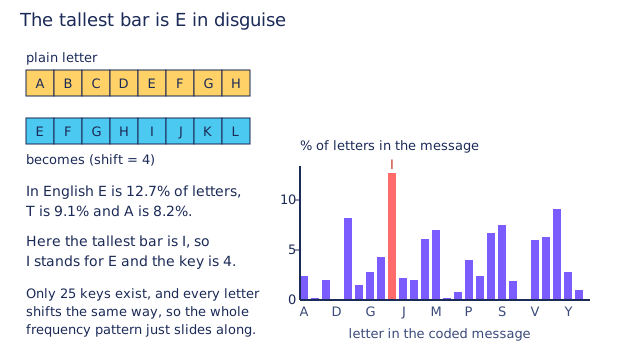
The letter counts are strongly uneven, with a few tall bars and many near zero. Matching the tallest bar to E usually gives the correct shift on the first or second attempt. A short message gives a flatter, less reliable chart.
🧪 Do it
- Write the alphabet twice around two card strips so one can slide against the other to give a shift.
- Choose a secret shift between 1 and 25 and encrypt your 200-letter message with it.
- Swap encrypted messages with your friend without revealing either key.
- Tally how often each letter appears in the message you received, and convert the counts to percentages.
- Draw a bar chart of the percentages and identify the tallest bars.
- Assume the tallest bar is E, work out the shift that this implies, and decrypt the first line to test it.
- If the first line is nonsense, try the next tallest bar as E and test again.
💡 Why it happens
A Caesar cipher shifts every letter by the same amount, so there are only 25 possible keys and the whole pattern of letter frequencies simply slides along. In English, E, T and A are the most common letters, appearing in roughly 12, 9 and 8 per cent of text, so the tallest bar in a long enough message is very likely to be E. Comparing a measured frequency chart with known language frequencies is called frequency analysis, and it is why a single fixed shift is hopeless for real secrecy. Modern encryption defeats it by making every occurrence of a letter encrypt differently, so the output frequencies come out nearly flat.
🔁 Now try this
Encrypt a 30-letter message with the same method and test whether frequency analysis still finds the shift.
🤔 Think about it
What kind of message would defeat frequency analysis even with a simple shift cipher?
🧘 Ask the Acharya
“What kind of message would defeat frequency analysis even with a simple shift cipher?” — ask him and he will explain it from your own chapters.
More for Std 9–12
Measure Gravity With a String
Six lengths of string, a stopwatch and one graph hand you the strength of Earth's gravity to within a few per cent.
Try it →Science40 minHow Fast Does It Fizz
The kitchen scale reading falls in real time, and the steepness of that fall is the speed of the reaction.
Try it →Science30 minHeart Rate Recovery Curve
The shape of your own recovery curve says more about your fitness than the peak number ever could.
Try it →