How Salty to Float an Egg
✨ The egg lifts off the bottom and hangs in mid-water at the exact instant the solution reaches the egg's own density.
🧰 You need
- a raw egg
- a tall jar
- 300 millilitres of water
- table salt
- a kitchen scale
- a spoon and a measuring cup
⚠️ Wash your hands after handling the raw egg and do not eat it afterwards.
👀 What you will see
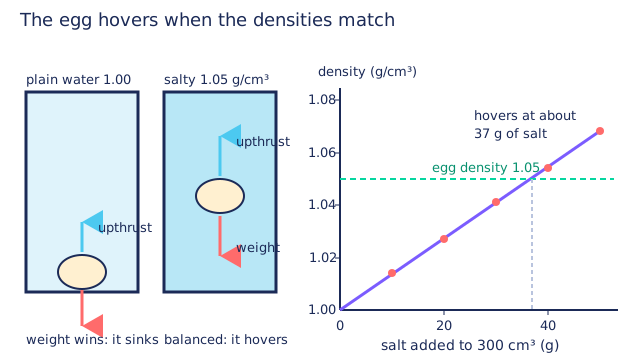
Nothing happens for the first few additions, then the egg suddenly lifts and hovers. The hovering point is usually reached at roughly 30 to 45 grams of salt in 300 millilitres. The calculated density comes out close to 1.05 grams per cubic centimetre.
🧪 Do it
- Measure 300 millilitres of water into the jar, weigh it, and lower the egg in to confirm that it sinks.
- Add exactly 5 grams of salt, stir until fully dissolved, and note whether the egg has moved.
- Keep adding weighed 5 gram portions, stirring completely each time, and record the total salt added.
- Stop at the point where the egg hovers without touching the bottom, and record that total.
- Measure the final volume of the solution in the measuring cup.
- Calculate the solution's density as total mass of water plus salt, divided by the final volume in cubic centimetres.
- Repeat the whole run once more and average the two density results.
💡 Why it happens
An object hovers in a liquid when the upthrust exactly balances its weight, which happens when the object and the liquid have equal density, mass divided by volume. Dissolving salt adds a lot of mass while increasing the volume only slightly, so the density of the solution rises steadily. The moment the solution's density passes the egg's density of roughly 1.05 grams per cubic centimetre, the upthrust wins and the egg rises. This is Archimedes' principle at work, and the same effect is why swimmers float so easily in the very salty Dead Sea.
🔁 Now try this
Repeat with sugar instead of salt, keeping the water volume identical, and compare the mass of each solute needed to reach the same density.
🤔 Think about it
A stale egg floats in plain water while a fresh one sinks, so what must be changing inside an ageing egg?
🧘 Ask the Acharya
“A stale egg floats in plain water while a fresh one sinks, so what must be changing inside an ageing egg?” — ask him and he will explain it from your own chapters.
More for Std 9–12
Measure Gravity With a String
Six lengths of string, a stopwatch and one graph hand you the strength of Earth's gravity to within a few per cent.
Try it →Science40 minHow Fast Does It Fizz
The kitchen scale reading falls in real time, and the steepness of that fall is the speed of the reaction.
Try it →Science30 minHeart Rate Recovery Curve
The shape of your own recovery curve says more about your fitness than the peak number ever could.
Try it →