The Best Launch Angle
✨ Your own measurements produce the peak at 45 degrees that textbooks simply assert.
🧰 You need
- a rubber band and a pencil or straw as a launcher
- a paper ball or straw rocket as the projectile
- a protractor or a card angle guide
- a long measuring tape
- chalk to mark landings
- an open outdoor space
⚠️ Launch outdoors away from people, faces and windows, and never aim the launcher at anyone.
👀 What you will see
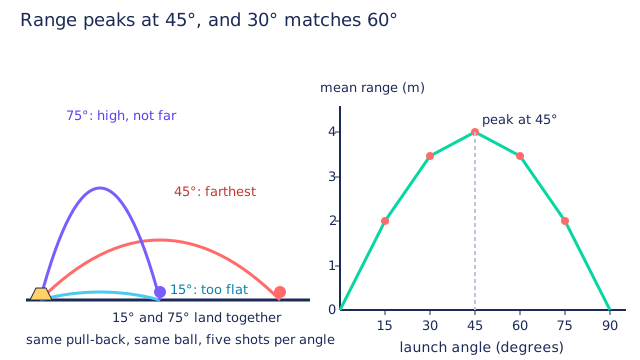
Ranges rise from 15 degrees to a peak and fall again towards 75 degrees. The curve is roughly symmetrical, so 30 and 60 degrees give similar ranges. The peak sits at or just below 45 degrees, and the five shots at each angle scatter by a noticeable amount.
🧪 Do it
- Build a simple launcher and mark the rubber band so you can pull back to exactly the same stretch every time.
- Set your angle guide and fire five shots at 15 degrees from the same launch point and height.
- Mark each landing with chalk and measure every range from the launch point.
- Repeat five shots each at 30, 45, 60 and 75 degrees, keeping the pull-back and the projectile identical.
- Calculate the mean range for each angle and note the spread of the five shots.
- Plot mean range against launch angle and draw a smooth curve through the points.
- Read off the angle that gave the greatest range and compare it with 45 degrees.
💡 Why it happens
Once launched, the projectile keeps a steady horizontal speed while gravity pulls it downwards, so its path is a parabola. The launch angle splits the launch speed between an upward part, which decides the time of flight, and a forward part, which decides how much ground is covered each second. With the same launch speed those two effects balance best at 45 degrees, where the range is greatest, and complementary angles like 30 and 60 give equal ranges. Air resistance and a launch height above the ground both pull the real best angle slightly below 45 degrees, which is why athletes and engineers measure rather than assume.
🔁 Now try this
Repeat at the best angle with a heavier projectile, keeping the pull-back the same, and see whether the best angle shifts.
🤔 Think about it
Why do shot-putters release at about 40 degrees rather than the textbook 45?
🧘 Ask the Acharya
“Why do shot-putters release at about 40 degrees rather than the textbook 45?” — ask him and he will explain it from your own chapters.
More for Std 9–12
Measure Gravity With a String
Six lengths of string, a stopwatch and one graph hand you the strength of Earth's gravity to within a few per cent.
Try it →Science40 minHow Fast Does It Fizz
The kitchen scale reading falls in real time, and the steepness of that fall is the speed of the reaction.
Try it →Science30 minHeart Rate Recovery Curve
The shape of your own recovery curve says more about your fitness than the peak number ever could.
Try it →