Weigh Gravity With Slow Motion
✨ A phone's slow-motion mode becomes a laboratory timer accurate to a few thousandths of a second.
🧰 You need
- a phone that records slow motion
- a measuring tape taped vertically to a wall
- a small dense ball
- books to prop the phone steady
- paper and a calculator
⚠️ Drop the ball away from people, windows and the phone itself.
👀 What you will see
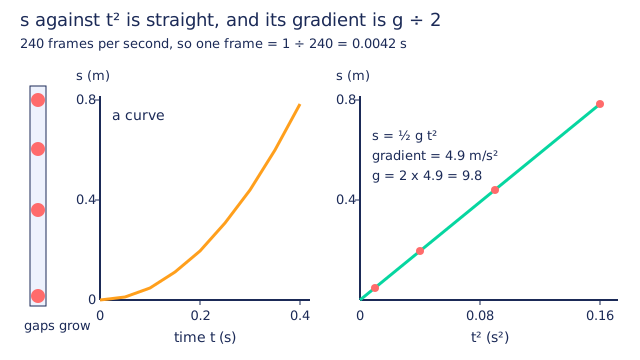
Distance fallen grows faster and faster, so distance against time is a curve. Distance against time squared is a straight line through the origin. Doubling the gradient gives a value for g usually between 9.2 and 9.9, depending on how carefully you read the scale.
🧪 Do it
- Tape the measuring tape flat to the wall so the scale is clearly readable on camera.
- Prop the phone on books about two metres away, framing the whole fall, and find out its slow-motion frame rate.
- Hold the ball at the top of the scale, start recording and release it from rest without any push.
- Step through the video frame by frame and note the height for each frame after release.
- Convert frame numbers to times by dividing by the frame rate, and tabulate distance fallen against time.
- Plot distance fallen against time squared and draw the best straight line.
- Take the gradient as half of g, double it, and compare your value with 9.81 metres per second squared.
💡 Why it happens
An object released from rest and pulled only by gravity accelerates at a constant rate g, so the distance fallen is given by s equals one half g t squared. Plotting s against t squared therefore gives a straight line whose gradient is g divided by two, which is why the graph is drawn that way rather than against t. A video at a known frame rate stamps a precise time on every frame, so the camera becomes a timing instrument far better than a hand-held stopwatch. Air resistance always makes the measured value a little low, and it matters far more for a light object than a dense one.
🔁 Now try this
Repeat with a table-tennis ball and a crumpled paper ball and compare the value of g you calculate for each.
🤔 Think about it
Why does your measured value come out slightly below 9.81 rather than above it?
🧘 Ask the Acharya
“Why does your measured value come out slightly below 9.81 rather than above it?” — ask him and he will explain it from your own chapters.
More for Std 9–12
Measure Gravity With a String
Six lengths of string, a stopwatch and one graph hand you the strength of Earth's gravity to within a few per cent.
Try it →Science40 minHow Fast Does It Fizz
The kitchen scale reading falls in real time, and the steepness of that fall is the speed of the reaction.
Try it →Science30 minHeart Rate Recovery Curve
The shape of your own recovery curve says more about your fitness than the peak number ever could.
Try it →