Salt Against Seeds
✨ Your graph shows the precise saltiness at which life simply stops starting.
🧰 You need
- fifty dried green gram or mung seeds
- five saucers lined with cotton wool
- salt and a kitchen scale
- a measuring cup for water
- a marker and a ruler
⚠️ Do not eat the treated seeds, and wash your hands after handling the solutions.
👀 What you will see
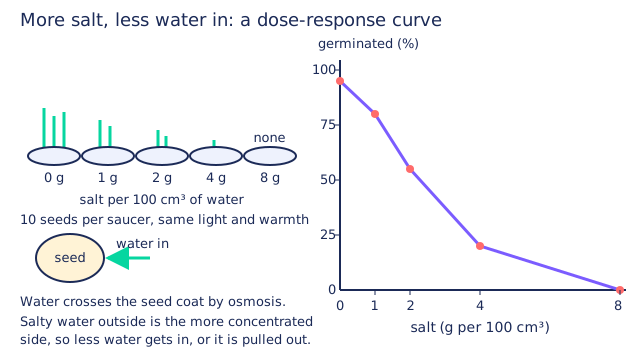
The plain water dish germinates almost every seed, usually within two days. Germination falls as salt rises, and the strongest dish may produce nothing at all. Shoots in the salty dishes are shorter and thinner even when they do germinate.
🧪 Do it
- Label the five saucers 0, 1, 2, 4 and 8 grams of salt per 100 millilitres of water, and mix each solution.
- Put ten seeds from the same packet on the damp cotton wool in each saucer.
- Add the same measured volume of the matching solution to each saucer, and keep them side by side in the same light and temperature.
- Top up each saucer daily with its own solution, using the same volume for all five.
- Count and record the number of germinated seeds in each saucer every day for seven days.
- On day seven measure the shoot length of every germinated seed and calculate the mean per saucer.
- Plot percentage germinated against salt concentration and describe the shape of the curve.
💡 Why it happens
A seed must absorb water before it can germinate, and water crosses the seed coat by osmosis, the movement of water across a partly permeable membrane from a weaker to a more concentrated solution. Salty water outside the seed is more concentrated, so water enters more slowly and, above a certain concentration, is even drawn out of the seed. Germination therefore falls as concentration rises, giving a dose-response curve rather than a sudden switch. The same effect ruins farmland when over-irrigation leaves salt behind in the soil, a problem called salinisation.
🔁 Now try this
Add a sixth dish at 16 grams per 100 millilitres, then use your graph to estimate the concentration that halves germination.
🤔 Think about it
Mangroves grow with their roots in salt water, so what must they be doing that these seeds cannot?
🧘 Ask the Acharya
“Mangroves grow with their roots in salt water, so what must they be doing that these seeds cannot?” — ask him and he will explain it from your own chapters.
More for Std 9–12
Measure Gravity With a String
Six lengths of string, a stopwatch and one graph hand you the strength of Earth's gravity to within a few per cent.
Try it →Science40 minHow Fast Does It Fizz
The kitchen scale reading falls in real time, and the steepness of that fall is the speed of the reaction.
Try it →Science30 minHeart Rate Recovery Curve
The shape of your own recovery curve says more about your fitness than the peak number ever could.
Try it →